
The Complete Guide to Cloud Cost Optimization for Fashion E-Commerce
Running a fashion e-commerce store in 2026 means living in two realities at once. On one side, you need lightning-fast infrastructure to handle thousands of concurrent shoppers. On the other, cloud bills can spiral out of control before you even realize what happened. Whether you're a boutique brand or a scaling DTC label, understanding cloud cost optimization isn't optional anymore - it's a core business skill.
What Is Cloud Cost Optimization?
Cloud cost optimization is the practice of reducing your cloud spending while maintaining - or even improving - the performance and reliability of your infrastructure. It's not about cutting corners. It's about spending smarter.
Most businesses overpay for cloud resources simply because they use a "set it and forget it" approach. They provision servers for peak demand and leave them running 24/7, even during quiet hours when traffic is minimal. For fashion retailers, this is a particularly costly habit.
The core idea is straightforward: pay only for what you actually need, when you need it. Achieving that requires a combination of visibility, automation, and strategic planning.
 Why Cloud Costs Get Out of Hand in Fashion Retail
Fashion e-commerce has a uniquely volatile traffic profile. Unlike everyday consumer goods, fashion demand is driven by trends, seasons, influencer moments, and viral content. This means infrastructure needs can swing dramatically - sometimes within hours.
Common culprits behind runaway cloud costs in this space include:
- Over-provisioned servers - Teams spin up large instances ahead of a campaign and never scale them back down.
- Unoptimized media assets - High-resolution lookbook images and video content stored and served without compression or CDN optimization.
- Redundant environments - Staging, testing, and dev environments left running indefinitely.
- Lack of tagging and attribution - Without proper cost tagging, it's nearly impossible to know which product line, campaign, or team is driving cloud spend.
- Data transfer costs - Moving data between regions or to third-party analytics tools adds up quickly.
The result? Cloud bills that grow faster than revenue - a dangerous pattern for any business, but especially for fashion brands operating on tight margins.
Key Strategies for Cloud Cost Optimization
There's no single fix for cloud overspend, but a combination of these proven strategies can deliver significant savings:
1. Right-Size Your Resources
Right-sizing means matching your cloud instance types and sizes to your actual workload requirements. Most businesses run instances that are 2-3x larger than needed. Regularly audit your CPU, memory, and storage utilization and downgrade where appropriate. Cloud providers offer tools like AWS Cost Explorer, Google Cloud's Recommender, and Azure Advisor to help identify oversized resources.
2. Use Auto-Scaling
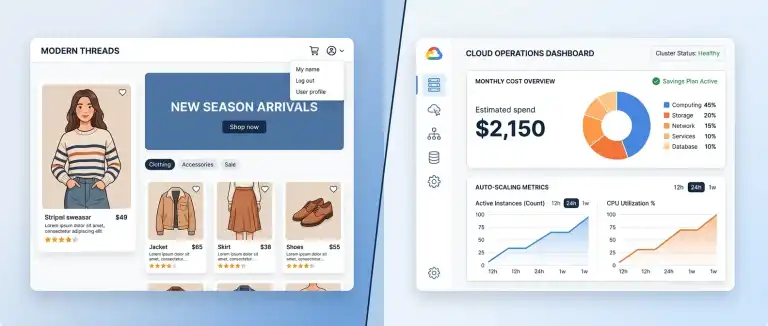
Auto-scaling automatically adjusts your compute capacity based on real-time demand. For fashion e-commerce, this is essential. During a quiet Tuesday morning, you might need 5% of the capacity you'd need during a Saturday flash sale. Auto-scaling ensures you're not paying for the Saturday setup on Tuesday.
3. Leverage Reserved Instances and Savings Plans
If you have predictable baseline traffic - which most established stores do - committing to reserved instances or savings plans can reduce compute costs by 30-60% compared to on-demand pricing. The key is to reserve only your baseline and use on-demand or spot instances for spikes.
4. Optimize Storage and Data Transfer
Implement lifecycle policies to move infrequently accessed data to cheaper storage tiers automatically. Use a Content Delivery Network (CDN) to serve product images and videos from edge locations closer to your customers - this reduces both latency and origin data transfer costs.
5. Implement Cloud Cost Governance
Set up budget alerts, enforce resource tagging by team or campaign, and establish a FinOps culture where engineering and finance teams collaborate on cloud spending decisions. Visibility is the foundation of control.
The "TikTok Virality" Traffic Spike: A Real Challenge for Fashion Brands
Here's a scenario that's become increasingly common: a fashion brand's product gets featured in a TikTok video that goes viral overnight. Within hours, traffic surges 10x, 50x, or even 100x above normal levels.
Without the right cloud architecture, one of two things happens:
- The site crashes - leading to lost sales, brand damage, and a missed viral moment.
- The cloud bill explodes - because the infrastructure scaled up to meet demand but was never configured to scale back down efficiently.
The solution lies in building for elastic scalability from the start. This means:
- Using serverless functions for variable workloads (e.g., product search, checkout processing).
- Deploying a globally distributed CDN for static assets and media.
- Implementing queue-based architectures to handle sudden order volume without overwhelming backend services.
- Setting scale-down policies that are just as aggressive as scale-up policies.
The brands that handle viral moments best are those that planned for them - not by over-provisioning permanently, but by architecting for elasticity and cost awareness simultaneously.
Cloud Cost Management Specifically for Fashion E-Commerce
Fashion retail has unique cloud infrastructure demands that general cost optimization advice doesn't always address. Here's what matters most for this vertical:
Seasonal Campaign Planning
Fashion operates on a calendar: Spring/Summer, Fall/Winter, Black Friday, end-of-season sales. Cloud budgets and scaling policies should be mapped to this calendar in advance. Pre-warm your infrastructure before peak periods and schedule scale-downs after them.
Product Catalog Management
Large fashion catalogs - sometimes tens of thousands of SKUs with multiple images each - create significant storage and delivery costs. Implement image optimization pipelines that automatically compress, resize, and format images for different devices and screen sizes. Tools like Cloudinary or imgix can dramatically reduce both storage and CDN costs.
Personalization at Scale
Modern fashion shoppers expect personalized recommendations, dynamic pricing, and tailored content. These features are compute-intensive. Optimize your recommendation engines by using caching layers, batch processing for model updates, and lightweight inference endpoints rather than running full models on every request.
Multi-Region Strategy
If your fashion brand sells internationally, serving customers from a single region adds latency and data transfer costs. A thoughtful multi-region strategy - paired with a CDN - balances performance with cost. Not every service needs to be replicated globally; identify what does and what doesn't.
Third-Party Integration Costs
Fashion platforms typically integrate with payment gateways, ERPs, warehouse management systems, marketing tools, and review platforms. Each integration can generate unexpected data transfer or API call costs. Audit these integrations regularly and consolidate where possible.
Finding the Right Cloud Cost Strategy for Your Business
Every fashion e-commerce business has a different cloud footprint, traffic pattern, and growth trajectory. The strategies outlined here provide a strong foundation, but the most effective approach depends on your specific technology stack, team capabilities, team size, and commercial priorities.
Some brands benefit most from right-sizing and reserved instances. Others find that serverless re-architecture delivers the biggest gains. For rapidly scaling DTC labels, building a FinOps practice from early on can prevent the cost chaos that often accompanies fast growth.
Exploring cloud cost management solutions, FinOps platforms, and infrastructure optimization tools tailored to your cloud provider - whether AWS, Google Cloud, or Azure - is a practical next step for any team serious about controlling cloud spend.
The Bottom Line
Cloud costs don't have to be a mystery or an uncontrollable line item. For fashion e-commerce brands, the stakes are particularly high: unpredictable traffic, media-heavy catalogs, and tight margins make cloud efficiency a genuine competitive advantage. By building visibility into your spending, architecting for elasticity, and aligning cloud strategy with your business calendar, you can scale confidently - whether you're preparing for a planned sale or riding an unexpected viral wave.